

Flexible packaging for bakery products.
“Bakery products” is a very broad category, ranging from fresh bread eaten the same day to biscuits with a shelf life of many months. This is why packaging requirements change radically depending on whether the products are fresh and perishable or dry with a long shelf life, often in single portions. Our proposal is built around this distinction.
Fresh bakery products: bread, focaccia, pizza, pinsa
For fresh bakery products the priority is to counter staling and mould growth, preserving the original fragrance and texture as far as possible. The solutions vary according to the desired shelf life:
• Simple vertical bagging, for bread and loose fresh products intended to be eaten the same day (e.g. bakeries, large-scale retail with fast turnover).
• Modified atmosphere packaging (MAP) or vacuum packaging, for products with an extended shelf life: it slows down mould growth and preserves the texture for longer, including products such as pinsa.
• Multilayer films with a high gas and moisture barrier, needed to make MAP or vacuum packaging effective on these products.
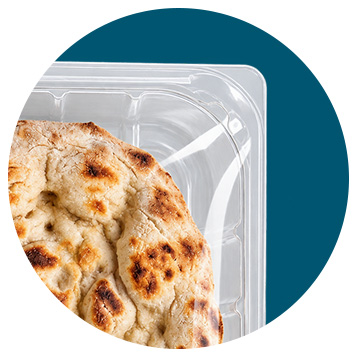
Focus on pinsa: the PET mono-material solution
Pinsa is today one of the most dynamic products on the fresh counter and needs packaging that combines extended shelf life, premium presentation and sustainability. For this product BEPACKS offers a fully PET mono-material solution, designed for thermoforming with modified atmosphere:
• Top in high-barrier PET mono-material film, available in a peelable version (easy, clean opening) or with a permanent seal, according to the needs of the customer and of the packaging line.
• Bottom in high-barrier APET mono-material sheet, which provides rigidity, mechanical protection and excellent transparency to showcase the product on the shelf.
• Option of APET sheet with 70% recycled PET, to reduce the use of virgin plastic without sacrificing performance.
Top and bottom are made of the same polymer, so the whole pack can go into the PET recycling stream without separating the components: a concrete advantage also in view of the recyclability requirements of the PPWR Regulation.
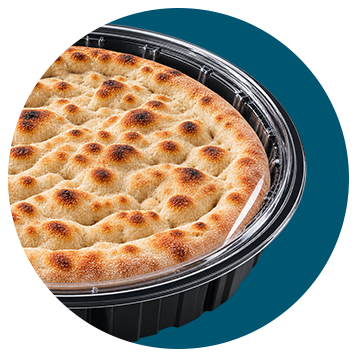
Frozen pizza and pinsa bases
For frozen bases the critical issues change: the product is fragile, travels in the cold chain and undergoes stacking, transport and handling at low temperature. BEPACKS has freeze-resistant APET mono-material solutions, which offer:
• Excellent mechanical strength even at low temperatures: APET keeps good toughness and impact resistance where other rigid materials become brittle and tend to crack.
• Structural rigidity, which protects the bases from breakage and deformation during stacking, palletising and transport.
• Dimensional stability along the whole cold chain, from freezing to storage at home.
• Transparency, to show the product even in the freezer cabinet.
• Mono-material construction and the option of recycled content, with the same recyclability logic as the solution for fresh pinsa.
Dry and single-portion bakery products: biscuits, crackers, breadsticks, snack cakes
For long-life products the main critical issue is moisture absorption, which makes them lose their crunchiness, and the oxidation of the fats in the dough or fillings, which leads to rancidity and loss of fragrance. Filled or cream products also need a grease barrier, to prevent the fats from migrating into the film and causing stains and loss of aroma.
Guide table by critical issue and typical technology
| Product | Main critical issue | Typical technology | Why |
|---|---|---|---|
| Fresh bread, focaccia, pizza, pinsa | Main critical issueShort shelf life, loss of crunchiness/fragrance, mould | Typical technologyVertical bagging (same-day consumption) or vacuum/MAP for an extended shelf life | WhyMAP or vacuum packaging slow down mould growth and preserve fragrance and texture for longer |
| Fresh pinsa with extended shelf life | Main critical issueMould, staling, shelf presentation | Typical technologyThermoforming in MAP: high-barrier APET bottom + high-barrier PET top, peelable or sealing | WhyBarrier and MAP extend the shelf life; PET mono-material makes the pack recyclable |
| Frozen pizza and pinsa bases | Main critical issueProduct fragility, impacts and stacking at low temperature | Typical technologyFreeze-resistant APET mono-material supports | WhyAPET stays tough at low temperatures and protects the product along the cold chain |
| Biscuits, crackers, rusks, breadsticks | Main critical issueMoisture absorption, loss of crunchiness, fat oxidation | Typical technologySingle-portion flow pack or multipack, high-barrier multilayer film | WhyThe product is dry and must be protected above all from moisture and oxygen to keep its crunchiness and fragrance over time |
| Snack cakes, filled or cream products | Main critical issueFat migration, loss of the product’s internal moisture | Typical technologyFlow pack with grease-barrier film | WhyFats from fillings and creams can migrate into the film if the barrier is not adequate, causing stains and loss of aroma |
Packing formats
• Flow pack (horizontal packaging, HFFS), sealed on three sides: the dominant format for single products such as brioches, biscuits, crackers and breadsticks, for speed and cost per piece.
• Vertical bagging, for loose fresh bread or products to be eaten the same day.
• MAP or vacuum packaging, for fresh bakery products with an extended shelf life target.
• Thermoforming with a rigid APET base and a sealed or peelable top, for fresh pinsa in MAP and for frozen pizza and pinsa bases.
• Multipacks with resealable film or opening zones, for family packs of biscuits or crackers.
Materials
• Solvent-free laminates, for maximum product wholesomeness and no residues in the film structure, a feature already central to BEPACKS’ current positioning in this category.
• Multilayer structures with a high barrier to moisture, oxygen and fats, for dry single-portion products.
• Multilayer films for MAP/vacuum packaging, for fresh bakery products with an extended shelf life.
• High-barrier PET mono-material solutions (top + bottom) for pinsa, with a peelable or sealing top.
• APET sheet with up to 70% recycled PET.
• Freeze-resistant APET for frozen bakery products.
• Recyclable mono-material solutions in PP and PET, in line with the market’s shift towards more sustainable materials.
• Flexographic printing in up to 10 colours.
Why bakery companies choose BEPACKS as their packaging partner
Separate paths for fresh bakery products (MAP/vacuum, extended shelf life) and dry single-portion products (moisture/grease barrier, high speed)
Complete PET mono-material solution for pinsa and APET supports for frozen products, with in-house production of the APET sheet by extrusion
Solvent-free lamination, for maximum product genuineness
High-barrier multilayer structures and recyclable mono-material solutions, defined according to the product
Flexible formats: flow pack, vertical bagging, MAP/vacuum, thermoforming, resealable multipack
Graphic customisation in up to 10 colours
Let’s talk about your flexible packaging for bakery products!
If you are considering a new partner for your packaging or want to optimise the performance of your pack materials, we can start from a technical discussion based on your production and preservation needs. BEPACKS experts respond with concrete, tailored guidance, not with off-the-shelf solutions. Contact us now!

Frequently asked questions about flexible packaging for bakery products (FAQ)
Because MAP, by replacing the air in the pack with a mixture of inert gases, slows down mould growth and staling, extending the shelf life of the fresh product well beyond what simple bagging can achieve. For bread to be eaten the same day, on the other hand, simple vertical bagging remains the fastest and most economical solution.
Because a top and bottom made of the same polymer make the pack mono-material and therefore easier to recycle, while keeping the high barrier needed for MAP and the rigidity that protects the product. With the 70% recycled sheet, the consumption of virgin raw material is also reduced.
Yes, if it comes from recycling processes authorised for food contact under Regulation (EU) 2022/1616, which is the regulatory reference for the use of recycled plastic in food contact materials.
No. APET is designed for storage, including at low temperatures, but not for cooking: the base must be taken out of the pack before it goes in the oven.
Because their perceived quality depends largely on crunchiness: even minimal absorption of moisture from the outside environment makes the product chewy or soft, spoiling the eating experience well before the expiry date on the label.
Because the fats in creams and fillings tend to migrate through lower-performance films, causing visible stains on the pack and loss of aroma in the product. An adequate grease barrier prevents this throughout the shelf life.
It means that the layers of the film are bonded without solvent-based adhesives, avoiding the risk of solvent residues in the final structure of the packaging. This is particularly relevant for bakery products, which are often eaten directly without further processing, and where the wholesomeness of food contact is an element of consumer trust.