

Flexible packaging for cereals and bars.
“Cereals and bars” is a convenient label, but it hides two products with opposite packaging needs: on one side breakfast cereals, muesli, granola, flakes, which live in the pantry and are eaten one spoonful at a time from a multi-portion pack; on the other cereal bars, almost always single-portion, which are born and die on a high-speed flow pack line. Same shelf, two different packaging worlds.
Breakfast cereals, muesli and granola: crunchiness comes first
For breakfast cereals the most critical characteristics are crunchiness, texture and crispness. They are compromised above all by two factors: moisture absorption (which makes flakes and puffed cereals soggy) and the oxidation of the natural oils contained in nuts and seeds, which leads to rancidity. This is why the packaging must provide an effective barrier to moisture and oxygen.
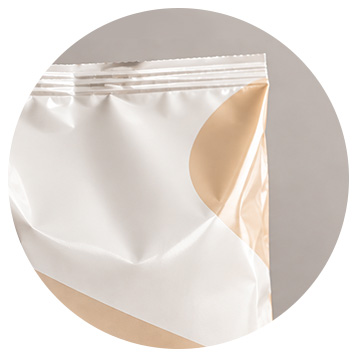
• Multilayer structures combining paper, aluminium, PE with and without EVOH, when a high barrier is needed on large formats
• Laminated polypropylene films (BOPP/PP – BOPP/PP MET), for a barrier to moisture, oxygen and odours with good print quality
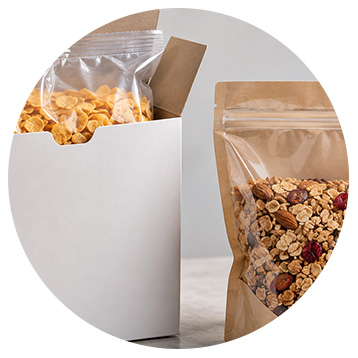
• Two-level pack: an outer cardboard box (graphics, shelf) and an inner bag in flexible film in contact with the product, the classic layout for family-size breakfast cereals
• Doypack with resealable zip, increasingly common for muesli and granola: the product is eaten over several portions, so reclosability is a functional requirement, not just an aesthetic one
Cereal bars: single-portion, high barrier, high speed
Cereal bars combine several critical issues in the same product: oats and puffed rice that absorb moisture, nuts and seeds that oxidise, and often a chocolate or dried fruit coating that quickly loses aroma and also requires a grease barrier. The film must also run without jamming on flow-wrap lines that reach up to 200 packs per minute.
The structures most commonly used in the sector for flow pack packaging of cereal bars:

BOPP / metallised PET / PE
Barrier level
Medium/High
Recyclability
07-Other
Not recyclable
Ideal for
Mass-market bars, high-speed flow pack

BOPP / metallised PP
Barrier level
Medium/High
Recyclability
05-PP
Recyclable
Ideal for
Mass-market bars, high-speed flow pack

Paper / metallised PP
Barrier level
Medium/High
Recyclability
C/PAP 81
Recyclable with paper
Ideal for
Organic / clean-label products

PET / ALU / PE
Barrier level
Very high
Recyclability
07-Other
Not recyclable
Ideal for
Export to hot and humid climates, bars with a high fat/nut content
Formats and customisation
• Flow pack (fin seal) for single-portion bars, the dominant format for speed and cost per piece
• Doypack with zip for multipacks of bars or for resealable cereals/granola
• Two-level pack (box + inner bag) for family-size breakfast cereals
• Flexographic or rotogravure printing in up to 10 colours
• Matt, soft-touch or selective metallised finishes for shelf impact
• Laser scoring for easy opening, resealable areas, tamper-evident seals
• Cold seal solution
Materials: mono-material and sustainable
For both product families, the market is moving towards recyclable mono-material solutions in PE or PP and towards paper/PE structures for organic/clean-label positioning.
Why cereal and bar producers choose BEPACKS as their packaging partner
Separate approaches for breakfast cereals (crunchiness, reclosability) and bars (single-portion, grease/aroma barrier, high speed)
High-barrier multilayer structures and recyclable mono-material solutions, defined according to the product
Flexible formats: flow pack, doypack with zip, two-level pack
Graphic customisation in up to 10 colours, with premium finishes
Compatibility with high-speed lines for flow pack packaging of bars
Let’s talk about your flexible packaging for cereals and bars!
If you are considering a new partner for your packaging or want to optimise the performance of your pack materials, we can start from a technical discussion based on your production and preservation needs. BEPACKS experts respond with concrete, tailored guidance, not with off-the-shelf solutions. Contact us now!

Frequently asked questions about flexible packaging for cereals and bars (FAQ)
Because their perceived quality depends almost entirely on crunchiness: even minimal moisture absorption makes flakes and puffed cereals soggy, and also increases the risk of mould forming during storage.
Because fats tend to migrate through lower-performance films, causing stains, loss of aroma and, in the most critical cases, the transfer of unwanted flavours to the film itself. An adequate grease barrier, typically provided by laminates with PET or aluminium, prevents these effects throughout the whole shelf life.
The first three structures — BOPP/metallised PET/PE, BOPP/metallised PP and Paper/metallised PP — all offer a high barrier level and are suitable for high-speed flow pack packaging, but they differ in recyclability: the version with metallised PET/PE is a non-recyclable multi-polymer structure, while the versions based on metallised PP (as a film or laminated to paper) are designed for high recyclability, and are better suited to mass-market or organic/clean-label products that want to improve their sustainability profile. PET/ALU/PE stands apart: thanks to the aluminium it offers the highest barrier of all, but at the expense of recyclability, and is therefore reserved for products exported to hot and humid climates or for bars with a high fat and nut content, where the extra protection is essential.
Generally yes, but with a different approach for the two product families. For bars we recommend mono-PP, which is more stable and suited to the barrier and speed requirements of flow pack. For breakfast cereals both mono-PP and mono-PE can be considered, but the choice depends heavily on the customer’s packaging machine: mono-PE has a much narrower processing window at sealing temperatures, so it requires specific attention during set-up; if the packaging machine is not sufficiently performant or precise in its temperature control, the material may not run correctly. This assessment should always be made together with the technical department, also checking the customer’s machinery.