

Flexible packaging for nuts and dried fruit.
“Nuts and dried fruit” covers two very different product families: nuts (almonds, hazelnuts, walnuts, pistachios, cashews, peanuts), rich in fats and therefore sensitive to oxidation, and dried or dehydrated fruit (apricots, prunes, figs, dates, raisins, cranberries), rich in sugars and sensitive above all to changes in moisture. The packaging must therefore protect against different enemies depending on the product, and at the same time showcase it on the shelf in a segment where a natural appearance and perceived quality drive the purchase. Our proposal is built around this distinction.
Nuts: almonds, hazelnuts, walnuts, pistachios, cashews
For nuts the main critical issue is rancidity: the unsaturated fats in the product oxidise on contact with oxygen and light, with loss of aroma and the appearance of unpleasant notes well before the expiry date. On top of this comes moisture, which makes roasted products lose their crunchiness and, in the most critical cases, encourages mould. The solutions vary according to the type of product and the desired shelf life:
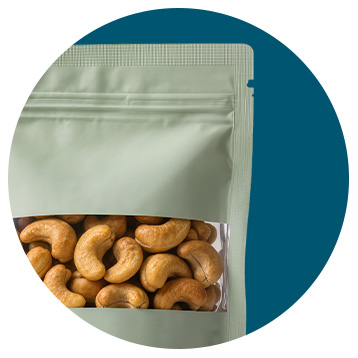
• Modified atmosphere packaging (MAP), with a high oxygen barrier film: nitrogen flushing reduces the residual oxygen in the pack and slows down rancidity, preserving aroma and crunchiness for longer.
• Light barrier, to protect fats from photo-oxidation: metallised films, opaque printing or small windows, to be balanced against product visibility.
• Moisture barrier, for roasted and salted products that must stay crunchy down to the last portion.
• Puncture resistance, needed for in-shell products or products with sharp edges (pistachios, whole almonds, roasted nuts): the film must withstand holes and micro-holes that would compromise the barrier and the protective atmosphere.
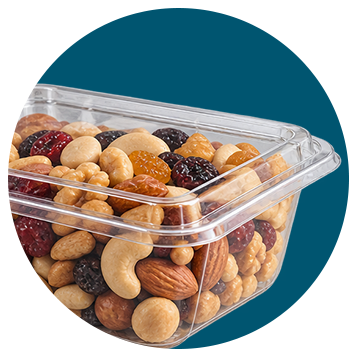
Focus on single-portion snacks and mixes
The snack segment (25/50 g single portions, trail mix, mixes of nuts and dried fruit) is today one of the most dynamic in large-scale retail, vending and on-the-go channels. Here the packaging must ensure high packing speed, an adequate barrier on small formats and strong graphic impact:
• Single portions in flow pack or vertical bags (VFFS), with high oxygen and moisture barrier multilayer film.
• Mixes of nuts and dried fruit, with the barrier sized for the most critical component: the fats in nuts need protection from oxygen, the sugars in dried fruit from moisture migration.
• Thermoformed trays in transparent APET sheet with a sealed or peelable lid, for premium products, assortments and mixes for the fruit counter or seasonal occasions.
Dried and dehydrated fruit: apricots, prunes, figs, dates, raisins
For dried fruit the priority is to keep the moisture content of the product stable. Soft fruit (prunes, apricots, figs, dates) must not lose moisture, so that it does not harden and keeps its texture; crunchy or freeze-dried fruit (strawberries, apples, mango) must instead not absorb any, so that it does not lose its crunchiness or become sticky. In both cases the high sugar content makes the product attractive to pests and prone to clumping, while the natural colour must be protected from light and oxygen to prevent browning.
• Moisture barrier, sized according to the texture of the product (soft or crunchy).
• Multilayer film with a good oxygen barrier, to preserve the natural colour and prevent browning of light-coloured fruit (apricots, apples, bananas).
• Reclosability with a zip, for products eaten on several occasions that, once opened, must keep their texture and protection from pests.
• Transparent film or window, to show the colour and natural look of the product, a key factor in the purchasing decision in this segment.
• Paper laminated to high-barrier film, for organic, natural and premium lines: it combines the natural look and printability of paper with the protection from oxygen and moisture provided by the film, also with a transparent window.
Guide table by critical issue and typical technology
| Product | Main critical issue | Typical technology | Why |
|---|---|---|---|
| Shelled nuts (almonds, hazelnuts, walnuts, cashews) | Main critical issueRancidity of fats, loss of aroma | Typical technologyHigh oxygen barrier multilayer film, MAP packaging with nitrogen | WhyOxygen and light oxidise unsaturated fats: barrier and MAP slow down rancidity and preserve the aroma |
| Roasted and salted nuts, in shell (pistachios, peanuts) | Main critical issueLoss of crunchiness, film punctures, oxidation | Typical technologyHigh moisture and oxygen barrier film, with high puncture resistance | WhyShells and sharp edges can puncture the film: a resistant structure keeps the barrier and protective atmosphere intact |
| Soft dried fruit (prunes, apricots, figs, dates) | Main critical issueMoisture loss and hardening, browning, pests | Typical technologyDoypack with zip or flow pack, film with moisture and oxygen barrier | WhyThe barrier keeps the moisture of the product stable and preserves its colour and softness even after opening |
| Crunchy or freeze-dried dehydrated fruit | Main critical issueMoisture absorption, loss of crunchiness | Typical technologyVery high moisture barrier film, often in MAP | WhyThe product is highly hygroscopic: even small amounts of moisture compromise its texture |
| Single-portion snacks and mixes | Main critical issueOxidation, moisture, packing speed | Typical technologySingle-portion flow pack or VFFS with high-barrier multilayer film | WhySmall formats and on-the-go consumption require a high barrier and a low cost per piece |
| Chopped nuts, nut flours and pastes | Main critical issueAccelerated rancidity (larger exposed surface) | Typical technologyHigh oxygen barrier film, MAP or vacuum | WhyProcessing increases the surface in contact with oxygen and makes the product even more sensitive to oxidation |
Packing formats
• Doypack with resealable zip, the most common format for nuts and dried fruit on the shelf: stable, resealable and with a large graphic surface, also with a transparent window.
• Pillow bag in VFFS, for family-size and mass-market formats, fast and economical to pack.
• Doypacks and bags in paper laminated to high-barrier film, also with zip and transparent window, for organic, natural and premium products.
• Single-portion flow pack and multipacks, for snacks, bars and on-the-go portions.
• MAP or vacuum packaging, for shelled nuts and chopped nuts with an extended shelf life target.
• Thermoformed APET trays with a sealed or peelable lid, for mixes, assortments and premium products.
Materials
• Solvent-free laminates, for maximum product genuineness and no residues in the film structure.
• High oxygen and moisture barrier multilayer structures, for nuts and products intended for MAP.
• Paper laminated to high-barrier film, to combine the natural look of paper with protection of the product from oxygen and moisture.
• Metallised films, to protect the products richest in fats from light.
• Structures with high puncture resistance, for in-shell nuts and products with sharp edges.
• Transparent APET sheet, also with up to 70% recycled PET, for thermoformed trays.
• Recyclable mono-material solutions in PP and PE, in line with market developments and with the recyclability requirements of the PPWR Regulation.
• Flexographic printing in up to 10 colours.
Why nut and dried fruit producers choose BEPACKS as their packaging partner
Separate approaches for nuts (oxygen and light barrier, MAP) and dried fruit (moisture management, reclosability)
Solvent-free lamination, for maximum product genuineness
High-barrier multilayer structures and recyclable mono-material solutions, defined according to the product
Solutions in paper laminated to high-barrier film, for natural and premium positioning without sacrificing shelf life
APET trays with in-house production of the sheet by extrusion, also with recycled content
Flexible formats: doypack with zip, pillow bag, single-portion flow pack, MAP/vacuum, thermoforming
Graphic customisation in up to 10 colours
Let’s talk about your flexible packaging for nuts and dried fruit!
If you are considering a new partner for your packaging or want to optimise the performance of your pack materials, we can start from a technical discussion based on your production and preservation needs. BEPACKS experts respond with concrete, tailored guidance, not with off-the-shelf solutions. Contact us now!

Frequently asked questions about flexible packaging for nuts and dried fruit (FAQ)
Because they are rich in unsaturated fats, which oxidise on contact with oxygen and light regardless of moisture content. This is why nuts above all need an oxygen barrier, often combined with modified atmosphere packaging with nitrogen, and protection from light.
Nitrogen is an inert gas that replaces the air inside the pack, reducing the residual oxygen. This slows down the oxidation of fats and preserves the aroma and fragrance of nuts. To be effective it needs a high-barrier film, which prevents outside oxygen from getting back in during the shelf life.
Because the main critical issue is different: for dried fruit what matters most is keeping the moisture of the product stable, preventing soft fruit from hardening and crunchy fruit from becoming rubbery or sticky. Nuts, on the other hand, must be protected above all from oxygen and light.
Yes, but it must be sized carefully: light accelerates the oxidation of fats, so for nuts a small window or a high-barrier transparent film is preferable, taking into account the desired shelf life and the conditions of exposure on the shelf.
Yes, if combined with a high-barrier film. Paper alone does not protect from oxygen and moisture, but laminated to a barrier film it offers adequate protection for both nuts and dried fruit, combining the natural look and pleasant feel of paper with the performance of high-barrier flexible packaging. It is a solution suited above all to organic, natural and premium products.
Because the shells and sharp edges of the product can puncture the film during packing, transport and handling. Even a micro-hole cancels out the effect of the barrier and the protective atmosphere: a structure with high puncture resistance is therefore needed.
Yes. Mono-material structures in PP or PE allow the pack to be disposed of in a single recycling stream while maintaining a good barrier, while for trays APET sheet is available, also with recycled PET content. The choice of structure must be calibrated to the barrier level the product requires.